Tentakulum Painters Threads Secrets
Of course, we won’t reveal all of our dyeing secrets
that make up our color gallery –
after all, some magic has to remain.
But we’ll give you some insights here
that will help you
to better understand the special features of hand-dyed threads.
🧬 Two fiber worlds – two color worlds
Plant-based fibers
– that is, all cellulose-based fibers like cotton or linen –
are fixed alkaline.
Animal fibers
– like silk or wool on an protein basis –
on the other hand, are fixed acidic.
This basic principle of hand dyeing leads
to very different color characteristics,
depending on which fiber is dyed.
And it is precisely these differences that make our threads so exciting –
because at Tentakulum Painters Threads they are
even enhanced by our special “hand-painting” technique.
🧪 Color that reacts
Our Tentakulum Painters Threads
are lovingly handcrafted
in our small dyeing manufactory.
We use fiber-reactive dyes that
– as the name suggests –
enter into a chemical reaction with the fiber.
This means:
The color bonds permanently with the thread,
which enables good wash resistance and color fixation.
But – and this is important:
What happens in industry with high pressure and chemistry,
succeeds in hand dyeing with feeling and patience –
but without aggressive fixing additives.
☝️ And now comes the honest part
The color in industrial dyeing
is literally shot into the fiber,
in order to penetrate as deeply as possible
and persuade many fiber atoms to connect.
In hand dyeing, on the other hand, people apply the color
with the pressure that their hands can generate.
The result?
A portion of color molecules always remains on the surface –
not quite as deeply anchored.
These molecules are sometimes a bit…
unfaithful.
They come off when washed –
similar to people who just leave
when things get too hot for them 😉
Particularly light-colored embroidery backgrounds
and white T-shirts in the same wash
don’t find that funny at all.
💡 Our tip:
Wash embroidery pieces separately –
or even better:
Dry clean.
Because every color that stays
is a sign of true handcraft.
🐑 Why colors appear differently depending on the material 🌿
The chemical reaction that occurs during dyeing
also explains why one and the same color
appears very differently on different threads.
🐑 Animal fibers such as silk or wool (i.e. protein fibers)
often reproduce brown
with a reddish undertone, for example.
🌿 Plant-based fibers such as cotton (cellulose fibers)
tend to appear lighter in brown –
and Rayon shows yet another,
often more intense color image.
🪄 A little color magic
We deliberately chose a brown in our color example
– because brown is a fascinating mixed color
and not at all boring!
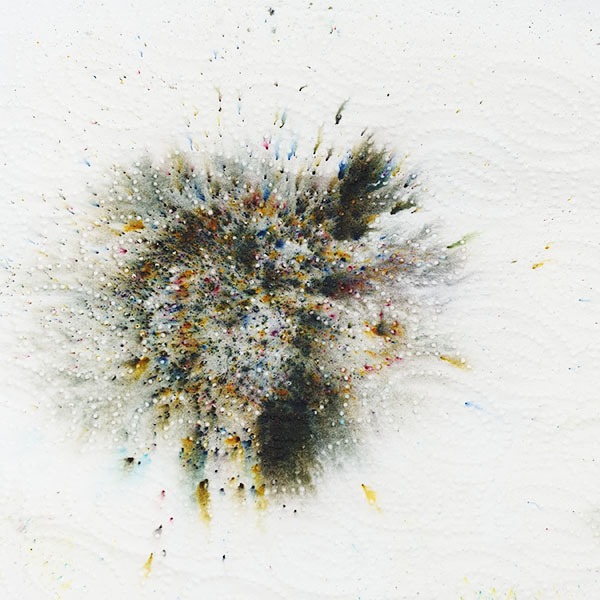
If you sprinkle the color powder on a white cloth
and dissolve it with water
– just like when creating the color solution –
it quickly becomes clear:
This color consists of many individual color pigments
that become visible in the solution –
small particles in a wide variety of nuances
that react with each other.
If we mix this color with another,
new, often unpredictable shades are created –
every mixture is a small adventure!
🧵 And then the material comes into play…
The thread itself also influences how the color is absorbed.
Not only the type of fiber
– e.g. cotton or silk –
plays a role,
but also the processing of the fiber:
All of this has an influence on
how the color refracts, shines or shimmers.
In short:
Each skein is unique
and that is exactly what makes hand-dyed threads so vibrant.
A practical example
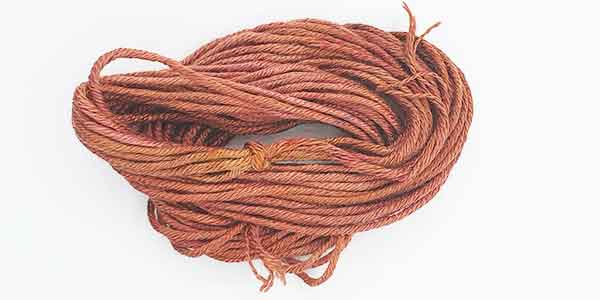
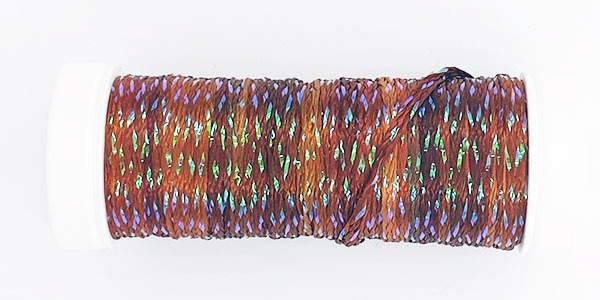
👩🎨The color 129 Friedrich
named after the North German painter Caspar David Friedrich
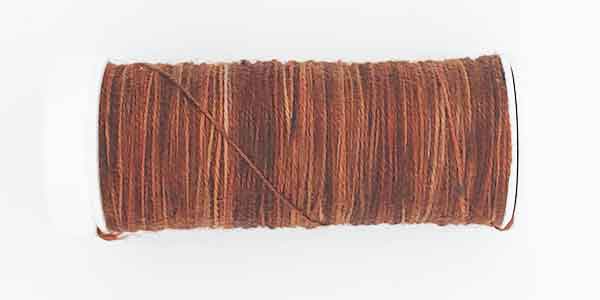
Baumwolle
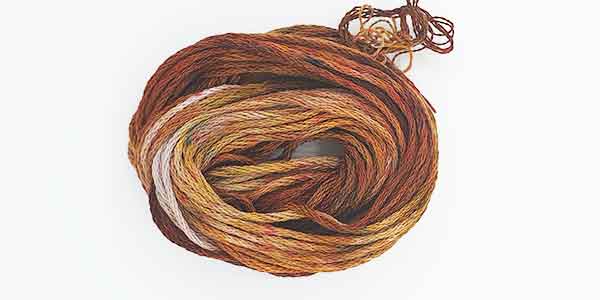
Baumwolle
Seide
Viskose
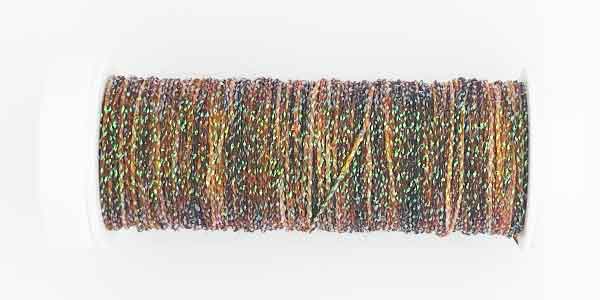
Cupro/Polyester
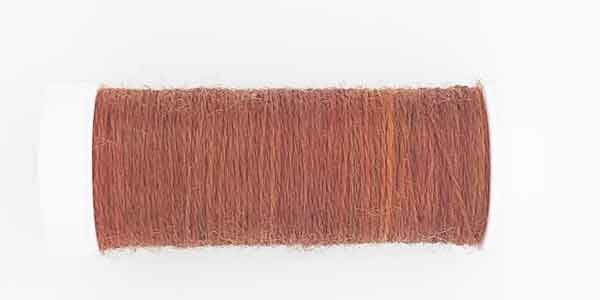
Wolle
🧑🏭What distinguishes hand dyeing from industrial dyeing
The difference between industrially dyed and hand-dyed thread
is particularly clear
when you look at a cross-section of a skein:
With hand-dyed threads
– especially with thicker qualities –
the core often remains lighter
because the dye liquid does not penetrate deeply into all the fibers.
The color is usually on the surface –
and that is what makes these threads so appealing.
🤲 No human being is a machine – fortunately!
People can never achieve the same precision as machines.
But isn’t that exactly what inspires us?
When a familiar shade suddenly turns into a new,
vibrant intermediate tone?
When every skein holds a little surprise?
The internationally renowned textile artist Heide Stoll-Weber, owner of “farbstoff”, once put it wonderfully:
“It’s so exciting every time you wait in front of the washing machine and don’t know what the product will look like this time.”
💃Colors dance with each other
A lot can be planned when applying color –
but not everything can be controlled.
For example, if I apply three colors to a thread,
I try to make the distances even.
But as soon as yellow suddenly comes into contact with blue,
a surprising green is created.
Red mixes with yellow –
and a rich orange is created.
And it is precisely these random color gradients that make hand-dyed threads
vibrant,
unique
and full of character.
🎊 Diversity instead of uniformitydiversity instead of uniformity
Hand dyers are
artists –
just like the people
who work with our threads.
We don’t love equality,
but expression,
change,
playing with colors.
And we would like
to encourage all creative textile designers
to embrace this diversity.
Because what emerges from it
is as individual as the person
who works with it.
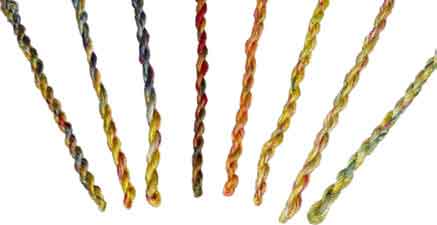
Different “forms” of the color 101 Macke
(shown in silk Stranded Cotton).
This is one of the most difficult colors,
because it contains yellow, red and blue.
A mixture that every book on hand dyeing warns against before putting it together…
🦋 Individuality in a uniform world
In a time when you can find the same logos of McDonald’s, H&M or Aldi
even in the most remote corner of the world,
it is a gift
to remember your own again.
Working with hand-dyed threads is a way to get there –
full of color, feeling and personality.
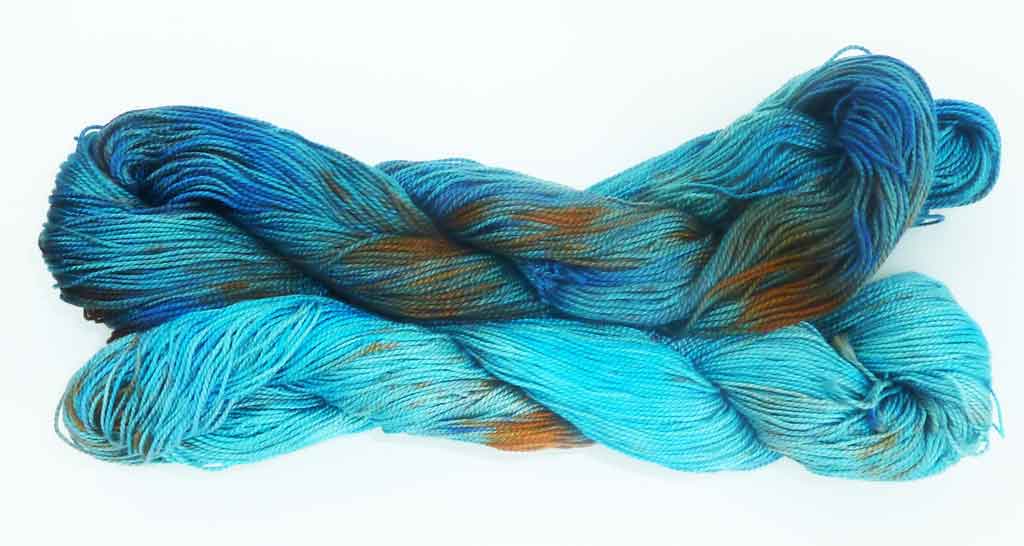
109 Picasso in Pearl Thread #8 – sometimes light – sometimes dark – although the mixture of the dye solution has not changed
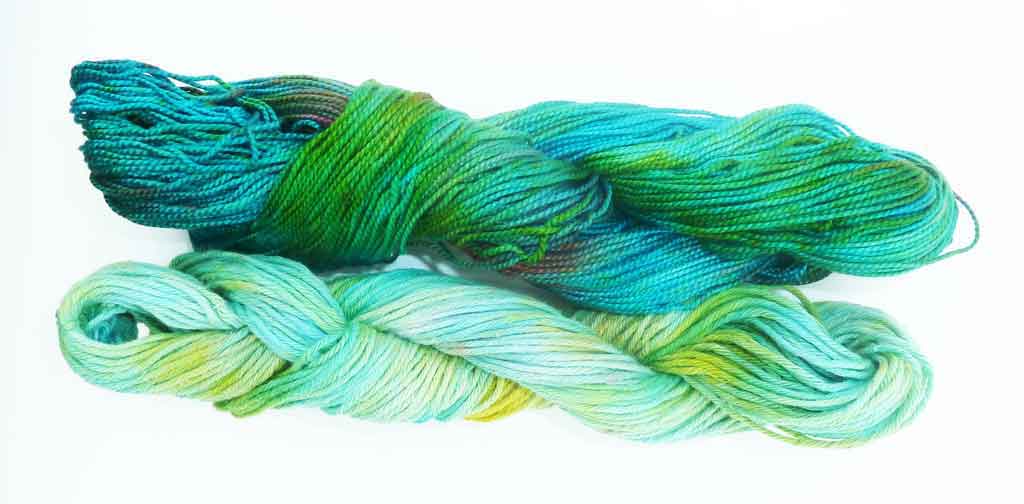
115 GrandmaMoses
above: Pearl Cotton #8 (mercerized cotton, strongly twisted)
below: Soft Cotton (non-mercerized cotton)
🌦️ When it’s not just people who determine the color
Sometimes it’s not even about the artistic creativity
of the dyer –
but about things that can hardly be influenced.
The result of a dyeing process depends on many factors
that are beyond our control –
and yet have a major influence:
Water quality
Soft water ensures stronger colors, hard water can make them appear duller.
Humidity
If the air is too humid, it makes it difficult for the color to penetrate the thread.
Pretreatment of the threads
Especially with cotton, e.g. the content of mercerizing liquor can vary – and thus influence the color result.
Cosmic influences
Yes really! According to our intensive observations, so-called flower days have a beneficial effect on cotton, fruit days on silk – and root days are… let’s say – unfavorable. 🌱🌕🌸
I tested this over months – with quite astonishing results.
🫗 Colors – a living material
Even the color powders we use
are subject to natural fluctuations.
The color “Jade” can tend more towards green or blue.
“Lemon” is sometimes bright yellow, sometimes slightly greenish.
And sometimes… it is simply no longer available.
Then it’s back to the dyeing table, new mixture, new tests –
often without a chance to exactly match the old tone.
The saying “Change is the only constant in life”
fits nowhere as well as in a dyeing workshop.
A chemist explained to a group of students who simply could not explain the secret of the constantly changing appearance of one and the same color: 40 out of 50 books on chemistry deal with color chemistry… After that, it was never questioned again that different dye baths are not only due to the skill of the person who produces the threads.
⚖️ Of spoons, powders and normal madness
The behavior of the color powders themselves also varies from delivery to delivery.
What was still fine-grained like sand yesterday
is suddenly flour-fine – and hardly soluble today.
Many hand dyers (including us!) do not work with gram measurements,
but with spoon measurements – because that is more practical in everyday life.
But: A spoonful of sand weighs more than a spoonful of flour.
And if the flour doesn’t want to dissolve, then…
sometimes all previous tests have been in vain. 😅
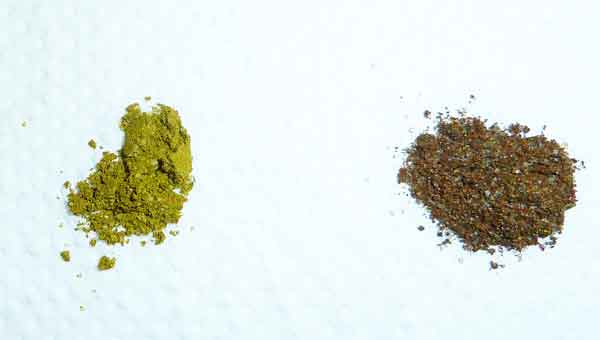
This color powder is one of our most important primary colors: Green.
On the left a delivery,
on the right the previous delivery.
In addition to the color, the consistency has also changed (see above),
mealy on the left, sandy on the right.
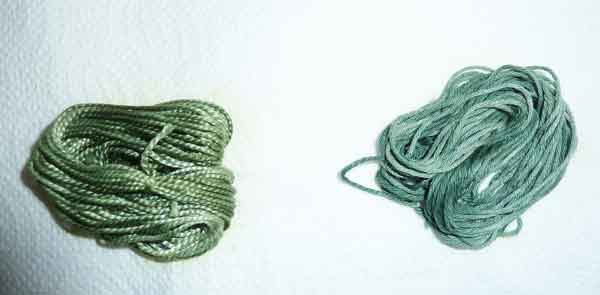
Sometimes you are lucky and the coloration looks similar. Unfortunately, this was not the case here. What was previously blue-green is now yellow-green.
You can certainly imagine that we would now have to retest all the mixtures that contain this color…
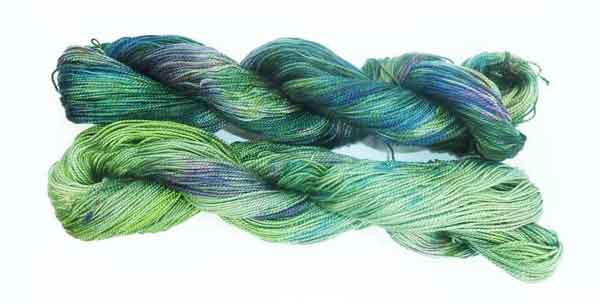
This is how different the color 121 Cezanne now looks,
which uses the green shown above as a base color…
above: old color powder
below: new color powder
Procion MX – and why “MX”
sometimes stands for magic
Many people know the popular fiber-reactive dyes “Procion MX”.
The “MX” stands for mixture,
because only a few colors in this series are actually pure.
Most tones consist of several components –
and although they are produced industrially,
there can also be differences from batch to batch here.
🧪Mixing from mixed colors – welcome to the color laboratory
To get our very own shades,
we mix our favorites together from these given mixed colors. Sounds complicated?
Sometimes it is 😅
Imagine we combine two sandy pigments –
both from different pigment mixtures.
Suddenly a delivery arrives
where one of the two shades
is floury instead of sandy.
What happens?
The mixture settles differently,
the heavier pigments sink faster –
and the original ratio is no longer correct.
👁️ Same to the eye – but different in result
Even if we shake the colors well before mixing them,
the heavier component can collect at the bottom.
The powder in the can looks completely familiar to our eyes.
But when dyeing it becomes clear:
The mixture is no longer exactly the same –
and the result deviates, often very slightly,
but sometimes surprisingly clearly.
🥳
And that is exactly what everyday life in a dyeing manufactory is like:
A game of
knowledge,
experience,
experiment
– and a good dose of patience.
A few more examples
of difficult colors,
that sometimes look like this
and sometimes like that…
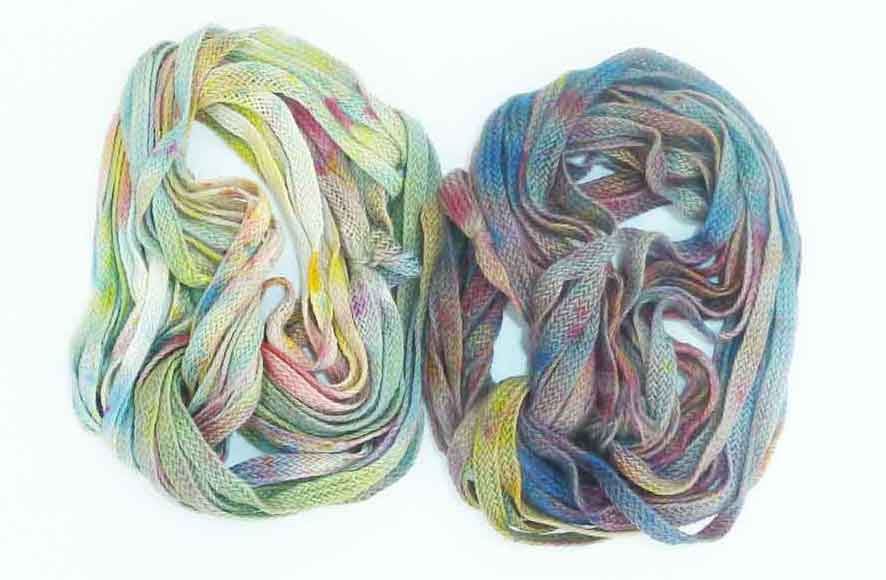
Baumwolltresse
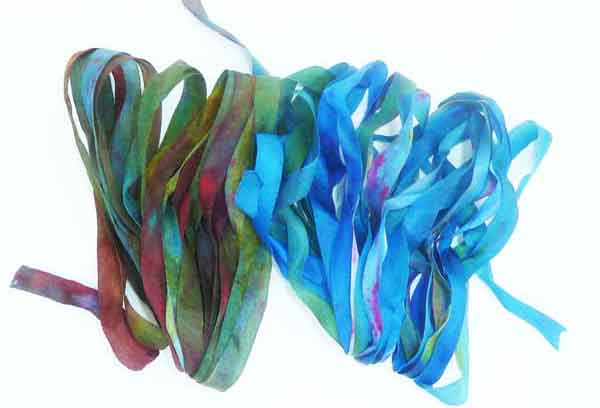
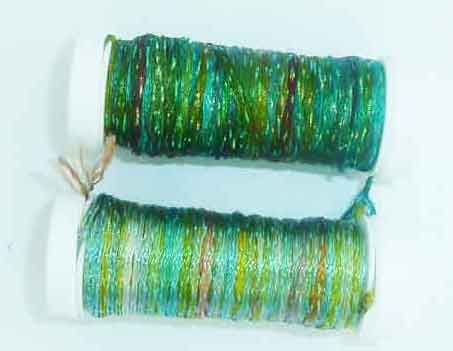
Farbe 115 “GrandmaMoses”